
A Chinese rug can look convincing from across the room and give itself away the moment you flip it over. The difference between a genuine vintage piece and a modern rug finished to look old almost always shows up in the same three places: the back of the rug, the behavior of the wool, and the honest history of where it has been. Robert and Holly Mosby have spent more than 55 years handling Chinese, Persian, and other Oriental rugs at Mosby Antique Oriental Rugs in Sarasota, Florida, and the checks below are the same ones they run before anyone starts talking about price.
If you want the wider context first, our guide to antique Chinese rugs covers the regional weaving traditions in more depth, and the antique rug identification hub walks through knot types and age clues for rugs of every origin.
Genuine Starts With One Question: Was It Hand Knotted?
The most useful test is also the oldest. A rug is genuine in the structural sense if it is hand knotted rather than machine made. That distinction matters because machine-made rugs, including the polypropylene copies that fill big-box stores, cannot reproduce the small irregularities that hand knotting leaves behind. A vintage Oriental rug simply has a look of authenticity about it that polypropylene rugs cannot match.
Turn the rug over and study the back. On a hand-knotted Chinese rug you should see individual knots tied by hand, rows that shift slightly rather than marching in perfect alignment, and pile ends that were cut by hand instead of tufted through a foundation. If the reverse looks like a printed grid, or like a uniform woven fabric with canvas glued to it, you are not looking at a hand-knotted rug.

Why “Antiqued” Rugs Exist and How to Spot One
Some rugs are hand knotted but made to look old. Buyers run into this constantly: a rug with genuine knots, an artificially faded palette, and a pile that has been shaved or chemically treated to imitate decades of wear. The giveaway is usually too much consistency. Genuine age is uneven. It collects in traffic lanes, thins near doorways, and often leaves the borders fuller than the center of the field.
One of the most reliable age signals in older rugs is the oxidation of the black dyes. Black wool corrodes over time and sits lower than the surrounding pile, which is why a genuinely antique rug can look as though the dark areas have sunk into the surface. That deeper pile in the blacks, paired with an overall loss of height, indicates an antique rug rather than a new one dressed up to resemble one.
Read the Wool, the Whites, and the Finishing
Chinese wool has a reputation for a reason. In older pieces the wool is shiny and silky, spun with greater thickness than typical Chinese wool used in later production. Run your hand across the pile and notice whether it feels dry and flat or has a soft, almost lustrous spring. Texture is difficult to fake and easy to feel once you have handled enough rugs.
Then look closely at the whites. In many older Chinese rugs the white or ivory areas are real silk, while in others they are cotton, and later production often substituted synthetic materials in place of silk. A practical test is to check whether the white surrounding is real silk, cotton, or synthetic. Be cautious with any rug marketed on the strength of silk highlights, because many of these rugs no longer carry genuine mulberry silk highlights even when the description insists they do.

Design and Regional Style as a Second Opinion
Structure tells you whether a rug is handmade. Design tells you whether the rug is what the seller claims it is. Chinese weaving traditions each have recognizable habits, and a rug whose pattern belongs to one tradition while its structure points somewhere else deserves a much closer look.
Peking Rugs
Peking Chinese carpets lean heavily on ancient symbolism and mythology. The central medallion is one of the clearest examples: a rounded medallion is often read as a symbol, and traditional commentary ties that rounded form to Confucian ideas. The field around it typically carries motifs drawn from the same symbolic vocabulary. A Peking attribution should arrive with that design language attached, not just a vague claim of age.

Art Deco Chinese Rugs
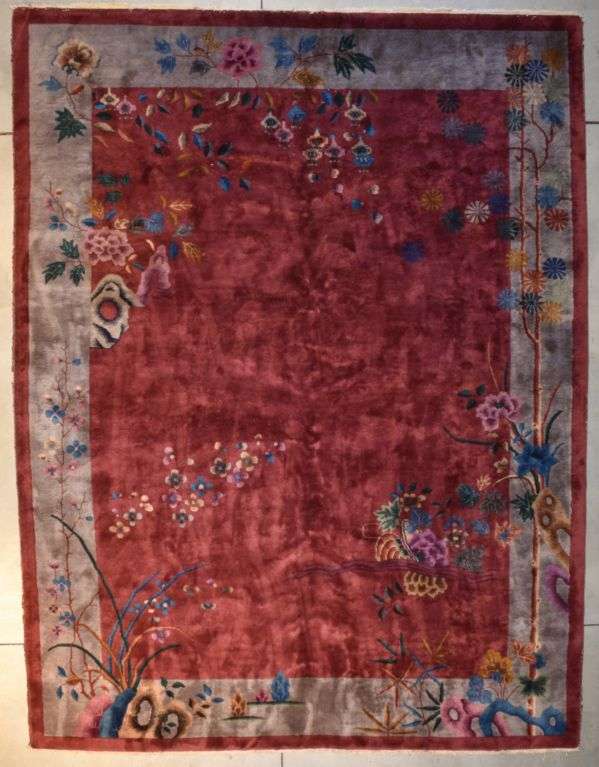
Chinese Art Deco rugs are immediately recognizable. The drawing is more geometric and modern than the classical repertoire, the palette tends to be bolder, and the composition favors strong blocks and stylized forms over dense floral fields. Because the style is so distinctive, misattribution is common, so bring the same structural checks to an Art Deco piece that you would bring to any other: knots, wool, wear, and finishing.
Symbolism Is Not Proof of Age
Symbols can be copied. A medallion, a cloud motif, or a Buddhist emblem in the field confirms that the weaver was working inside a Chinese design tradition. It says nothing on its own about when the rug was made. Use symbolism to identify style and origin, then use structure and condition to judge age.
Provenance and the Paper Trail
Provenance is the least glamorous test and often the most decisive. A photograph of a great-grandmother standing on the rug, an old insurance list, a receipt, or a family note about where a piece was purchased all narrow the window of age. When a rug has never left the family, that history can be more convincing than any single visual clue.
Where documentation is missing, you are relying on physical evidence alone, and that is when the price question becomes harder. Do not treat a compelling family story as a substitute for inspection, and do not treat an inspection as a substitute for documentation when a seller is asking a premium.
What Genuineness Does Not Tell You About Value
Hand knotted does not automatically mean expensive. Genuine and valuable are two separate judgments, and the second depends on condition, age, rarity of design, size, color, and current demand. A genuine vintage Chinese rug with heavy wear, replaced ends, or an unfashionable palette can be worth far less than a smaller piece in superb original condition.
Auction results are one reference point for value. They are also easily misused, because a number reached at auction is only as accurate as the value of that specific rug at that specific sale. It should never be applied wholesale to a different rug with different condition or design. Treat past auction prices as a range worth investigating, not a valuation you can copy across.
A Quick Inspection Checklist
- Turn the rug over. Look for individual hand-tied knots and pile ends cut by hand.
- Check the blacks. Oxidized black dye sitting lower than the surrounding pile points toward genuine age.
- Feel the wool. Older Chinese wool tends to be shiny, silky, and spun thicker.
- Inspect the whites. Determine whether the white areas are silk, cotton, or synthetic, and stay skeptical of silk highlight claims.
- Study the wear pattern. Uneven wear along traffic lanes suggests real use over a long period.
- Match the design to the tradition. Peking and Art Deco Chinese rugs each have their own visual language.
- Ask for history. Photographs, receipts, and family records support everything else.
- Get a second opinion before a large purchase. Verification and valuation services exist for exactly this reason.
When to Bring In an Expert
There are many facets to antique rug identification. There is a point where self-inspection stops being useful. If the rug is large, if the asking price is significant, or if the seller’s description and the physical evidence disagree, an expert appraisal settles the matter. Someone who verifies and values Chinese rugs can confirm materials, assess condition, and place the piece inside a realistic value range.
Experience is the part that cannot be shortcut. More than five decades of handling rugs gives a dealer a feel for the difference between a genuinely old pile and one that has been helped along, and that judgment is worth paying for on any rug you plan to live with or resell. If you are buying from a gallery, ask directly how the age was determined and what evidence supports it. A confident seller will answer in specifics.
Frequently Asked Questions
How can I tell if a Chinese rug is hand knotted?
Turn the rug over and examine the back. Hand-knotted rugs show individual knots tied in slightly irregular rows, with pile ends that were cut by hand rather than tufted through a backing. Machine-made rugs, including polypropylene copies, have a uniform back and cannot reproduce that irregularity. If the reverse looks printed or glued to canvas, it is not hand knotted.
Does oxidized black dye always mean a rug is antique?
Oxidized black dye, which leaves the dark areas sitting lower than the surrounding pile, is one of the strongest indicators of genuine age in an older rug. It is not proof by itself, because rugs can be hand knotted and then deliberately treated to look old. Combine the oxidation check with wool texture, wear patterns, and any documentation you can find.
Are silk highlights in a Chinese rug a sign of quality?
Not by themselves, and the claim deserves scrutiny. In older Chinese rugs the white or ivory areas may be real silk, cotton, or a synthetic substitute, and many rugs sold with talk of silk highlights no longer contain genuine mulberry silk. Check the white areas directly and ask the seller to identify the material.
Is a genuine vintage Chinese rug automatically valuable?
No. Genuine speaks to how the rug was made, while value depends on condition, age, design rarity, size, color, and demand. A hand-knotted Chinese rug with heavy wear or replaced ends can be worth far less than a smaller piece in excellent original condition. Auction results give a reference range, not a guaranteed price.
Should I get a vintage Chinese rug appraised before buying?
For a large rug or any significant purchase, yes. Verification and valuation services exist specifically to confirm materials, age, and condition, and to place a rug inside a realistic value range. If the seller’s description and the physical evidence do not line up, an independent appraisal is the fastest way to resolve the disagreement.