
Art Deco rugs hold a special place in the history of the carpet. Created during a remarkable period of creative exchange, these early-twentieth-century modernist carpets combine bold geometry, streamlined motifs, and luxurious materials. They were designed for fashionable interiors of the 1920s, 1930s, and into the 1940s, and they remain as striking today as when they first appeared.
Among the most coveted examples are Chinese Art Deco rugs. Produced in the same decades, these hand-knotted carpets blend Eastern tradition with Western Art Deco style, creating a look that appeals equally to collectors of Chinese art and devotees of modernist design.
At Mosby Antique Oriental Rugs in Sarasota, Florida, Robert Mosby has spent more than 55 years studying, buying, and selling these extraordinary pieces. The gallery offers authentic antique and vintage handmade Persian, Chinese, and Oriental rugs, backed by decades of family expertise. This article explores what defines an Art Deco rug, why the Chinese examples are so special, and what collectors should look for.
What Defines an Art Deco Rug
Art Deco emerged as a design movement in the early twentieth century and shaped everything from architecture to furniture to textiles. On the floor, it produced rugs with a bold, confident character. The hallmarks are well documented: geometric patterns, rich colors, symmetry, angularity, and superb attention to detail.
Unlike flowing, organic earlier styles, Art Deco carpets favor crisp lines and repeated motifs. A classic example might feature a central medallion framed by sharp borders or an all-over pattern built from stepped forms and stylized florals. The overall effect is order, balance, and quiet luxury, which is why these rugs still suit modern interiors so well.
Although the movement reached its peak in the period between the world wars, its influence never faded. Antique and vintage Art Deco rugs remain wonderful additions to contemporary rooms, and the style is still popular with designers today.
The Chinese Art Deco Rugs
Chinese Art Deco rugs are a fascinating chapter in rug history. From the 1920s to the 1940s, workshops in Tianjin and Beijing, including those associated with Walter Nichols, produced rugs that combined China’s weaving heritage with the geometric language of Western Art Deco. The result feels both ancient and utterly modern.
These rugs were hand-knotted, which sets them apart from many commercial carpets of the era. They were created for export, designed to appeal to Western buyers who wanted the exotic charm of a Chinese carpet in a style that matched their contemporary interiors.
To understand where these pieces fit in the larger story, it helps to look at the traditions that came before. The antique Chinese rugs that connoisseurs collect today laid the groundwork. Earlier Peking rugs refined the palette and motifs of Chinese weaving, while the oldest Ningxia rugs contributed bold symbolic designs that echoed through later generations. Chinese Art Deco rugs drew on this deep well of imagery and recast it in a modernist key.
Wool Density and Hand-Knotted Construction
One of the first things a collector notices about a quality Chinese Art Deco rug is its body. These rugs were hand-knotted, and the best examples have a thick, substantial feel. The dense wool pile is one reason they have survived so well for nearly a century.
In descriptions of Art Deco rugs, a thick body and feel comes up again and again, and for good reason. The density of the wool affects how a rug wears, how it springs back underfoot, and how clearly its pattern reads from across a room. A tightly knotted carpet holds its geometric motifs with crisp precision, while a looser weave blurs the design.

The Colors of Art Deco Rugs
Color is where Art Deco rugs make their boldest statement. Rich colors were central to the style, and Chinese Art Deco rugs are admired for the depth and intensity of their dyes. Geometric patterns are often set against deep grounds, with contrasting borders that frame the field with clarity.
The result is a rug that can anchor a room. Because the colors are so strong, a Chinese Art Deco carpet can define a space on its own, exactly as the designers of the 1920s and 1930s intended.
Botanical and Asian Iconography
When Chinese weavers took up the Art Deco style, they did not abandon their own motifs. Instead, they wove them into the new geometric framework. Peonies appear in full bloom, their layered petals softened by the crisp lines around them. Lotus flowers add graceful, open forms. Dragons, one of the most powerful images in Chinese decorative art, coil through fields and borders with a new angular energy.
These botanical and mythical elements give Chinese Art Deco rugs their distinctive character. A rug may read as purely abstract across the room, then reveal its flowers and dragons up close. That combination of bold geometry and fine detail is what makes these rugs so rewarding to live with.

Nichols-Style Carving and Minimalist Designs
Among Chinese Art Deco rugs, the pieces associated with Walter Nichols occupy a special place. His workshops helped define the genre, and his name has become shorthand for a particular look. Nichols-style rugs are admired for carved surfaces, where sections of the wool pile are cut at different heights to create sculptural relief. The carving gives the geometric patterns a depth that flat surfaces cannot match.
The Nichols style also includes minimalist designs. Some of the most collectible Chinese Art Deco rugs are nearly abstract, relying on a few bold shapes and a restrained palette. These pieces fit traditional interiors, and they look equally at home in modern living rooms, which helps explain their enduring demand.
Decorating with Art Deco Rugs
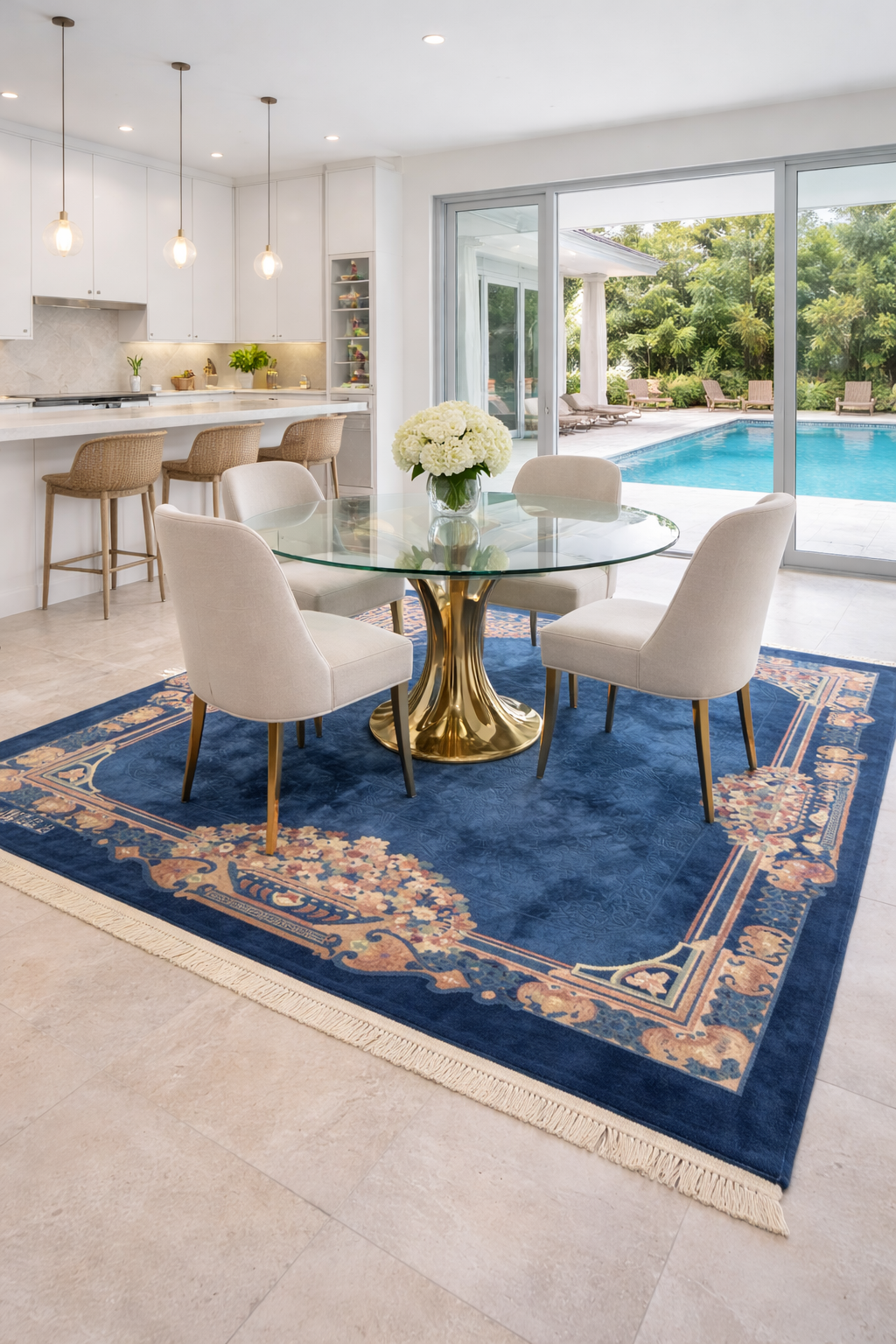
Art Deco rugs bring vintage sophistication to a room through bold geometry, luxurious materials, and striking symmetry. For designers, they offer a way to introduce pattern and color without overwhelming a space. A single Chinese Art Deco rug can anchor a seating area, define a dining room, or add warmth to a bedroom.
Because the style is rooted in symmetry, these rugs pair well with furniture that has clean lines. They also hold their own beside older antiques. The mix of Eastern iconography and Western geometry means a Chinese Art Deco carpet rarely feels out of place in any decorative scheme.
Collecting Art Deco Rugs with an Expert Eye
Serious collectors know that authenticity matters. The market for Art Deco rugs includes original hand-knotted pieces from the 1920s and 1930s, as well as modern reproductions in grid-tufted and hand-knotted constructions. Modern rugs made in wool can capture the look, but they do not carry the history of the originals.
For more than 55 years, Robert Mosby has helped collectors across the United States find authentic antique and vintage rugs. His family-run Sarasota gallery, Mosby Antique Oriental Rugs, is built on knowledge and trust. Beyond selling exceptional carpets, it serves as an educational resource with rug identification guides and articles on knot types, age determination, and regional weaving traditions.
Collectors and designers rely on Robert’s expertise to verify authenticity, evaluate wool quality, and select pieces that will hold their value. The gallery provides appraisal and purchasing support, and every rug is chosen with an eye toward investment-grade quality.

Frequently Asked Questions
What does an Art Deco rug look like?
Art Deco rugs are defined by bold geometry, streamlined motifs, and luxurious materials. They typically feature geometric patterns, rich colors, symmetry, and angularity, with superb detail throughout. Chinese Art Deco rugs add traditional motifs such as peonies, lotus flowers, and dragons, so the look can range from purely abstract to richly pictorial.
Are Art Deco rugs from the 1920s or the 1930s?
The Art Deco style is closely associated with the 1920s and 1930s, and the carpets themselves were made for interiors of the 1920s through the 1940s. Chinese Art Deco rugs were produced mainly in this same period. The movement spans both decades, and the finest examples from either period remain highly collectible today.
Are Art Deco rugs handmade?
Antique Chinese Art Deco rugs were hand-knotted, which is a major part of their appeal. They have a thick, substantial body and may include wool-and-silk blends with a subtle high-low texture. Modern Art Deco style rugs are also available in hand-knotted and grid-tufted wool constructions, but original pieces from the 1920s to 1940s are the ones collectors seek.
Is Art Deco making a comeback?
Art Deco has never really left. It is a design movement from the early twentieth century that remains popular today, and antique and vintage rugs are wonderful additions to contemporary interiors. The bold geometry and rich colors fit naturally with modern design, so collectors and decorators continue to seek them out.